Social Interaction, Photography, and Social Media Metrics Response

The Social Photo

The article talks about how photography as a new medium had a similar history and change to how we see the world as social media has. We are similarly unsure about how it effects the way we view and interact with society because of how new it is. It speaks to how photography in the social media context has switched from being something too special to being an everyday image that we use to document our lives moment to moment, as both communication, and a media object. Combined this makes social photography, both in a professional sense, but more-so in the amateur photographers that are now creating this new type of photo and interaction with the world that didn’t use to exist and it has become one of culture, memory, and expression.

What might the evolution of the social photo look like in the coming age of surveillance awareness?

What can’t we measure…?

I think at its core this talk accentuates that metrics dont always equal accuracy. Data is not always reality. And sometimes it leaves out the important information. I really enjoyed the example of the sex tracker because it really emphasized this point. This tracker can’t measure love, and I’d say it cant measure satisfaction, but it does give data. I took away something important which is the fact that data is not always 100% accurate. My phone is giving me a metric that is guessed and knowing that variable is important to whether or not that data is actually important or useful. Measurements aren’t always helpful and aren’t always necessary.

What do metrics want?

As the article puts it, this piece is about the influence of metrics on our lives, analyzing it through the lens of capitalism influencing our worth as humans and how facebook specifically is made to continue this influence. On the first hand, the article explains that our personal worth is defined by social interaction which I am one to agree with. Often times our lives are defined by outside sources, whether that be society as a whole, or whether or not one specific person likes us landing us a job. So much is out of our control and influenced by how good we are at networking, making friends, political plays even outside of politics. If we do all these things correctly, know the right person, do the right thing at the right time, we can be successful. I think this is how we want more, because it reduces our likelihood of missing out on an opportunity. This is how facebook plays into our minds, as the article states, our feeds our empty without having interaction with our friends or pages. As we gain friends we gain more content. And as we connect with more people our facebook also becomes a reflection of our social lives. One can look at our page and see who we are, which includes possible new opportunities. Facebook can be used as a social platform but also as one of advertising and the cycle continues with more reinforcement and engagement this can be money, friends, content but in the end it is just more of what our brains want and what the system wants.
Social Interaction, Social Photography, and Social Media Metrics Response

The Social Photo– Nathan Jurgenson
The first part of this reading talks about photography and how it has allowed us to document life in new ways and to share those snap shots of lived experiences with other people. Jurgenson says “it changed the possibilities of time and space, privacy and visibility, truth, and falsity” (5). How we see photography is constantly changing as society progresses and tries to keep up with the modifications in how we see ourselves and the world. I think photography 20 years ago and how we define visibility, privacy, memory, death, time, and space is very different than how we see it today. This has a lot to do with new technologies, social media, etc… Being called a photographer today and 20 years ago also holds a very different meaning…. Social photography are everyday images taken to be shared… Jurgenson treats social photography “less as an evolution in photography or as the advance of amateur snapshot photos, and more as a broader devlopment in self-expression, memory, and sociality” (11). He doesn’t want to define social photography as just photography done on a smart phone shared on social media but as a “cultural practice…a way of seeing, speaking, and learning.”

Interesting quotes:
“To understand our social world today means
understanding the ubiquity of digital communications and social media, and this media is deeply constituted by the images we make and share. Any contemporary social theory should be, in part, a theory of social media, which should be, in part, a theory of social photography” (11).

What did social photography look like before social media? Or does social photography exist because of social media?

What can’t we measure in a quantified world?– Jill Walker Rettberg
What I found most interesting (around 16:23) is when she mentioned Alice Marwick. Marwick argues that social media has metrics to bring it’s users up to be really good post industrial citizens (need to be self branding, entrepreneurial on a personal level.) The metrics on social media & even the fitbit shows how we are trying to improve ourselves. At first, I wasn’t sure why Rettberg brought up the fitbit. But just as we trust these metrics without question, we try to improve our daily lives but exercising and walking as much as we can. We are constantly tracking our steps and finding ways to improve. Social media metrics are similar in the way that we use likes, shares, followers, etc… as a measure of improving ourselves. We take those data and we use it to become better ‘social media users.’

These metrics only take data from numbers, but what are some things that can’t be measure by numbers that are essential in social media platforms like instagram, etc…?

What do Metrics Want? How Quantification Prescribes Social Interaction on FB– Ben Grosser!!
Personal worth manifests as a desire for more. Our personal worth is highly dependent on social interactions which can only be be fulfilled within the confines of capitalism, and capitalism is always about growth. Facebook for instance, draws on our desire for more and sees our desires in a quantitative form. These metrics influences our motives and desires because we crave for attention and it provides what we want which is more likes, friends, comments, etc… Facebook’s metrics creates a pattern for more, which is why users are addicted. I wonder how different social media would be if people didn’t look to these metrics. But I guess social media wouldn’t be called social media or be the most leading form of communication if it didn’t adhere to want humans want the most.

I feel like this can work just the same for instagram. Our desire for personal worth is found in the number of likes we get, which is why instagram was designed in metrics and numbers just so that we will continue to use it.

Is social media metrics never ending? As in, is it a constant cycle of wanting, then achieving, and then wanting more?


The Social Photo/Media Metrics Responses

Nathan Jurgenson’s The Social Photo: Jurgenson describes social photography as photos people take/share of their everyday life (i.e. selfies, food pics, etc.) in order to communicate. It started with point-and-shoots, but has since changed to smartphone cameras… I swear I have witnessed ‘amateurs’ turning more and more professional on social media… After reading this, I now know ‘pics or it didn’t happen’ was first coined by Emile Zola in 1901. Ah 1800s photography, takes me back to high school when I took an old-school/dark-room/black and white film photography class. I’ve never heard of Hipstamatic, but obviously I know about Instagram. And yes, ‘vintage’ things kept making a comeback in the 2010s. Maybe it will still continue in the 2020s… I’m kind of reeling from the fact that I’ve never thought twice about why we use the terms/metaphors ‘file’ or ‘folder’ on the computer… The idea that the gentrification of inner cities demonstrates middle/upper-middle class white people’s desperate search to find authenticity outside of the fakeness of the suburbs/Disney/McDonald’s troubles me.

  • Can you be nostalgic for a time you never lived during or a place you’ve never been?
  • Do you think the fascination with vintage looks is caused by nostalgia or a need for authenticity? Both? Neither?
  • Do you see yourself as taking photos of experiences rather than objects?

Jill Walker Rettberg’s What can’t we measure in a quantified world?: Walker begins her talk explaining her activity in Fitbit graphs and then segues into describing this more recent phenomenon of being able to ‘measure’ yourself (via geolocation or residual data on phones/’wearables’). Walker considers automation to be a human dream since it seems anything humans do can now be measured by machines. For children, it’s tracking their schooling based on how much discipline they received and/or time they spend on homework (reminiscent of the SpotterEDU attendance app). For babies, it’s monitoring their milk intake, weight, and/or sleep (with an ankle bracelet?). I do firmly believe that humans desperately try to find patterns where there are none. Walker debunks the idea of Dataism, a belief that data is always true, by suggesting the steps her Fitbit counts is not definitive because the device might be moving without her feet. This talk reminded me of my boyfriend who downloaded a sleep app and has been showing me his graphs. Of course me and a dog are also sleeping in the same bed, so it’s probably finicky at best. Side note, I did like seeing Johanna Drucker’s subjective visualization which acknowledged gender as not rigidly binary.

  • Do you think social media has made you a post-industrious citizen?
  • Would you use a sex tracker which measures bed movements and noise? Why? I guess if you wanted to obfuscate it you could just play a bunch of porn…

What do Metrics Want? How Quantification Prescribes Social Interaction on FB: A future where quantity matters more than quality depresses me… Recently I have been a lot more passive than active on Facebook. I don’t write posts, like, or comment all that much. I think high numbers and the ‘more, more, MORE’ mentality overwhelm me (I should really be using the Facebook Demetricator). I mostly go online to see what others are doing; it’s kind of like living through others’ posts (which may not be super healthy, but I can’t help that I’m a hardcore escapist). I can’t argue that capitalism thrives on us wanting more. I’m not surprised Facebook will use metrics to manipulate people into clicking an ad. Clearly this article is slightly dated, since it only talks about likes, I’m curious how Facebook views the emotional responses? If I’m sad or angry about a post are they less inclined to show me similar posts? I never thought the number of friends you have on Facebook could correlate to social capital, but yeah, these days it feels like there’s more of an emphasis on social networking now than ever before. I don’t like the thought of me being ‘homogenized’ by a system. I do think it’s funny that someone would have anxiety over liking something unpopular.

RE: Social Interaction, Social Photography, and Social Media Metrics

What Do Metrics Want? How Quantification Prescribes Social Interaction on Facebook

Schäfer makes it abundantly clear what he thinks of Facebook and the interactions it encourages in media by referring to it as “bastard culture”. Enumerating socializing and using it to lift markets is pretty bastard-y. Capitalizing on human interaction is immensely bastard-y. I feel particularly disgusted with this concept that a capitalist framework is the only way people can achieve fulfillment psychologically. This may be me just immediately lurching at the assertion – which sounds incredibly dystopian and disingenuous – but yeah no, I highly doubt anyone knows enough about human interaction to charge such a massive claim like that. Fuck that. Quantification is ingrained in people from the youngest age inherently through money – which is viewed not as a resource, but as a score. Grades in school are not so much a level of ability but a score. This socializes people to go for the highest score – which is generally fine and dandy unless your efforts to get the highest score include creating a system that kills a lot of people and preys on

Wearables and how we measure ourselves through social media

I really like this usage of personal data – far more than any other usage. Having a personal device collect and express this data in order to provide insight and maintain agency in the hands of the user is phenomenal but can of course be dangerous given poor guidance based on health data. Jill mentions using wearables to modify posture by immediate feedback – managing the kinds of food you eat – managing the amount of alcohol. In the hands of the user and appropriate guidance otherwise, this is amazing. In the hands of administrative bodies, this is surveillance and needs to be used appropriately given balance for needs for security and needs for privacy.

The Social Photo

While this is plainly clear to most everyone, I find that in many ways – especially outside of academia – we don’t discuss how the ways we communicate are technologies in their own right. Communication began with Body Language, occasional vocalizing if physically applicable, and has led to communicating by way of a complex structure of computers transmitting bits much faster than it would take most people to physically say all the words in their message. The image being captured and not painted by hand lends to the image itself being a witnessing party in a way that no person could ever be, short of someone with a quite literal photographic memory. Much akin to how we deal with software updates (poorly), updates like the addition of nearly definitive imagery or facial recognition or sentient computers are bound to shake things up in shocking, bizarre, and perhaps dangerous ways.

Social Interaction, Social Photography, and Social Media Metrics (12 Feb):

Nathan Jurgenson – The Social Photo – (book, pp. 1-15)

This reading discussed the rise of different technologies changing the way the masses think and perceive information. They drew a similarity to the rise of photography, and how its inception changed how people viewed time since they could suddenly capture moments of time in an image. Photos became so important so quickly, and most of the popular apps these days involve some sort of photo. The photograph has actually changed society so much — it kind of brought us to an image-obsessed society, where people care about how they present themselves and how they look above most other things.

Jill Walker Rettberg – “What can’t we measure in a quantified world?” (talk, 20m)

This TED talk is talking about tracking devices (like FitBit) that track our activities to encourage behaviors based on the information it collects about us. The speaker talks about how this quantitative behavior tracking isn’t a new thing because people like Ben Franklin tried to improve themselves through behavior tracking as well. I think it’s really helpful to track behaviors like this so we can feel accountable for our behaviors that we are trying to change.

Ben Grosser – What do Metrics Want? How Quantification Prescribes Social Interaction on FB (article)

The article is talking about how much sites (mainly Facebook) use numbers and metrics as a measure of social interaction, which in turn drives an “insatiable desire for more”. This is emphasized and brought to light in the video that Ben made with Mark Zuckerberg talking about numbers and metrics for almost a whole hour. It makes sense to me that people would become obsessed with this — humans are social creatures, so I don’t find it unusual that people want to be validated and have a sense of belonging through social metrics, to the point where their self worth depends on it, or at least is impacted in a big way through these metrics of social interaction, and makes me think about why the companies choose to show certain metrics over others, and if they are aware that they are doing this.

BFA Exhibition Idea

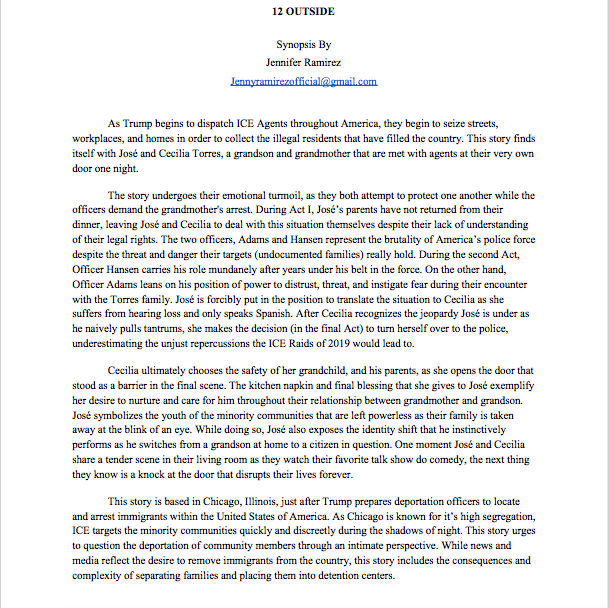
  • Subject: I’ve attached below my synopsis of the potential short film that I plan to pursue.
  • Form and Method: I plan on producing it from pre production to post. I’m considering forming a group to help me produce it since it can be quite big. Having people that can help with conceptualizing, camera work, etc will allow me to work on it more in depth. As for the final piece, I would like it to be screened at the gallery preferably with some physical set up to help emphasize the concept.
  • Context and Audience: I’m influenced heavily by my past experiences and the way they have been shaped by my identity. As a latinx women born and raised in Chicago, I strive to represent my community and the ways that we are stereotyped and given space. Aside from merging video and installation art, I am thinking about publishing it onto online platforms for a broader accessibility.

Interface Criticisms

In the book Programmed Visions Wendy Chun explains how the use of technology has become part of how we view ourselves and the world. I thought it was interesting when she mentioned how we view things such as molecules and senors in the human brain as software, and physical things in nature as hardware. I think with her saying this really shows how much that we let technology dictate how view the world even before these imaginary and invisible systems were created. 

When do you think we will go too far with technology to where we can’t tell it apart from real life, or will we be consumed by the invisible existence of software and use that as our reality?

In the Team Human podcast, there was a lot of discussion to further drive home the point that humans’ feelings and emotions are starting to become more similar to how technological systems work. There was a lot in this podcast that I go agree with. We rely on these systems for human connection and interact when it’s not enough to have these connections, so they basically become artificial. It’s almost like humans becoming the machines.

Is there a way we can spread awareness about this to people?

In the excerpt from How to be a Geek by Matthew Fuller, he explores the ideas of the people who are geeks are the ones that control how technology and the money behind our technology and the money that is made from it. He mentioned how this is a thriving time for geeks because they are so invested in it. I think that this is true, the people who are really into the ideas of these systems are the ones who are in control,. But they like to play it off as if they aren’t part of these systems or they don’t have as much power as they actually do. 

How can we not let the power of these geeks control just about everything we do?

The article written by Soren Pold explains how the meta interface affects us more than most people know. We think that we are just interacting with the interface and that there is no relationship between us, but that is not the case. The interface is actually noticing us and is interacting with us, which is something that can be pretty detrimental. 

How do we get people to care about how their privacy isn’t well protected?

BFA Proposal Ideas

(I made a google slide that included images, but I’ll add it on here as well)

I have a couple ideas in mind, but I am interested in incorporating both fashion/videography or some form of technology in my final BFA project.

Some artists I looked into, inspired me:
-Jung Yeondoo
Six Points 2010
https://www.youtube.com/watch?v=GV3bT6Skmp0 https://paddle8.com/work/yeondoo-jung/16368-Six-Points/
“Six Points is a still image from a video by the same name, in which Jung shot thousands of individual photographs in six different neighborhoods in New York City (including Koreatown, pictured here) and edited them together into a moving, dreamlike vision of the city.”

JR
The Chronicles of San Francisco
https://www.youtube.com/watch?v=gezqUGBwvbs https://www.youtube.com/watch?v=bPal0sE5NSc https://www.sfmoma.org/press-release/sfmoma-announces-public-unveiling-of-major-installation-by-artist-jr-on-may-23/

“a digital photo-collage scrolling across a seamless span of screens stretching over 100 feet in SFMOMA’s Roberts Family Gallery”


Some Sort of Fashion Editorial on paper form (editorial magazine) as well to incorporate clothes that I make or that I buy… Want to possibly make a theme of motion in my video… ??

Or…

Fashion Film:


Interface Criticism / Tactical Media / Software Art

Wendy Chun – Programmed Visions

Software is a part of new media that opens up many doors to explore the complexity of the world. There is merit to understanding the intricacies of this medium, as the article puts it, understanding software is in some way a form of enlightenment. There is a sort of relationship between visibility and invisibility within the medium that makes it a powerful force in the new media age. There is still this question of how it truly works, as a big part of it is still unknown to us and that’s something to explore and discover within this new and growing tech that is emerging.

My question is, is this something to be explored on an individual basis? What are the tools that we should acquire beforehand to get a better and deeper understanding of the mechanisms of software?

Matthew Fuller – How to be a Geek

This article is doing the opposite of what we’d consider gatekeeping, in that it is suggesting that the culture and community surrounding the software and technical aspect of the world is not just limited to the experts and the ‘geeks’ that are enthused by the evergrowing interest of software. Although ‘geeks’ are known to be somewhat like the face of the internet obsessors, the actuality of the situation is that everyone is open to explore the knowledge of software, regardless of expertise. We are all allowed to ‘geek’ out. This article also discusses the relationship between technology and humans, in that the contemporary technology we know of is “not an extension of man”, rather, it is a complex technical medium that aids in our ability to understand the world more.

My questions for this would be, is there a way to present the knowledge of software and technology in a more accessible and less intimidating way to reach a wider range of people? Should everyone be thought more about the usage of software in school and everyday life? What can we do to remove the stigma of being a ‘geek’ so that people are less apprehensive about the idea of technological exploration?

Geert Lovink – Sad by Design

This article introduces and discusses the lack of control we actually have when it comes to the extremely complex and intricate technology we possess in our pockets, and how our experience with it has been monopolized and capitalized to benefit the provider as opposed to the user. Major corporations have successfully captivated their users to succumb to the need to use their apps and tech through means of behavioral analyses that they have used to develop addicting tech. The youth, especially, are so engrossed in their phones that they are bound to check it every so often and this is because these capitalist organizations have figured out the best way to sink us deep into the rabbit hole that is a technological obsession. They have also honed into the inciting emotions (sadness, in particular, commonly extracted from female users) to keep us drawn in.

What can we do to bring awareness to this capitalist scheme for other users so that we can collectively learn to un-engross ourselves in technology?

Soren Pold – New ways of hiding: Towards meta interface realism

Within the complexities of the worldwide web comes the question of who is actually in control of being seeing and being seen. In this article, the author goes over different ways the meta interface collects data from everyday users and does so under a camouflage that makes it hidden from everyone else unless it is actively being searched for. This interfacing is both voluntary, (meaning it is present in the terms and conditions that the user can agree to) and involuntary (where there are activities that happen in the background that tracks and stores user activity and information without them even realizing it). The article introduces a possible method to explore and find out about how this happens through the form art and presents several artists who have explored and successfully presented the myriad of ways the meta interface tracks us in the dark.

What can regular users do to become more aware of this occurrence as well as protect our own information and be more secure about it to the best of our ability?

Wendy Chun – Programmed Visions, (book, pp. 1-2, and optionally pp. 3-10)

– I find it sort of reassuring that even somebody who seems to be an expert in technology and how it works (or at least enough to write a book about it) finds it very difficult to understand. Software really is a hard thing to fully comprehend. The way it encapsulates, technology and allows us to output whatever we use it for will always be too complicated to see through it all. Another thing I found intriguing about this reading was how software is a metaphor and how it can be applied to anything not related to technology. I think we’ve discussed this before in a seminar class. Software can used to describe culture, ideology, economy, and many other aspects of society and how humans function. 

Matthew Fuller – How to be a Geek (book, pp. 12-14, and optionally pp. 63-71)

The vocabulary used in this reading is very impressive. The way that a geek is described is very articulate. I have never really thought of an individual categorized as  a geek to be living with these characteristics. But it really does make sense and there is a reason that they have transformed our world with dominant media conglomerates. 

Translating being a geek into survival instincts, and personality traits was very informing and I thought this was a good read.

Geert Lovink – Sad by Design (podcast w/ Douglas Rushkoff, 60m)

What was birthed in the bay area is that humans are computational and computers can do it better than humans. This was taught at Stanford. What was taught is that the answer to our problems is that algorithms program peoples behavior. Facebook, Google, Amazon, Uber are examples of companies that create machines the replace things that were previously done by humans. We’re not being beaten by machines, but by the billionaires who build them. Geert Lovink mentions that if we don’t connect with our deep wishes and our behaviors in the online world, then it will be hard to differentiate what is real. Technology is so intertwined in our world and we have to be aware of that. My names Jordan and I’m on Team Human.

BFA ideas…..

For my project I am going to make a video exposing certain non profit organizations. I will be focusing on organizations that raise funding for disease, and showing why they aren’t doing anything to find cures. There is certain meal plans, and advertising campaigns that are promoted by cancer, diabetes, and heart disease organizations that are the cause of the disease that they claim to try and cure. I think I will be doing a documentary style video. I haven’t thought too much into the whole process…but I know I will focus on the American Cancer Society, the American Diabetes Association, and the American Heart Association. I will be going over their recommended meal plans, health tips, and who there sponsors are and why they are making sure America stays unhealthy, and sick. I want to have a lot of cool infographics and tie it all into a video.